
Por favor, use este identificador para citar o enlazar este ítem:
https://repositorio.uca.edu.ar/handle/123456789/22240| Título: | El significado en Nicea Helenización, tradición viva y filosofía del lenguaje Meaning at Nicaea. Hellenization, Living Tradition, and Philosophy of Language |
Autor: | Fritz, Mariano | Palabras clave: | HELENISMO; TRADICION; FILOSOFIA DEL LENGUAJE; Wittgenstein, Ludwig, 1889-1951 | Fecha de publicación: | 2026 | Editorial: | Pontificia Universidad Católica Argentina. Facultad de Teología | Resumen: | El concilio de Nicea (325) constituye un hito decisivo en la historia del cristianismo,
especialmente por la condena del arrianismo y la elaboración de la profesión de fe
que introdujo el término homoousios. Esta novedad terminológica dio lugar a inten-
sas controversias en torno a la legitimidad del uso de conceptos extraescriturísticos
para la expresión de la fe y al riesgo de una eventual distorsión del mensaje cris-
tiano. Estas objeciones reaparecieron con fuerza en los siglos XIX y XX en la obra
de Adolf von Harnack, quien interpretó la historia del dogma como un proceso de
progresiva helenización del cristianismo. Si bien dicha tesis ha sido ampliamente
discutida y criticada, el presente artículo busca ofrecer una contribución adicional
mostrando que la acusación de Harnack se apoya en una concepción rígida del
significado, que identifica el sentido de los términos con su origen conceptual. A
partir del examen del uso de términos como ousía, homoousios e hypóstasis en textos
vinculados al concilio de Nicea, y recurriendo a aportes de la filosofía del lenguaje,
se argumenta que los Padres nicenos hacen un uso no determinista del lengua-
je teológico, que les permite incorporar nuevos términos resemantizándolos en el
contexto de la Tradición viva de la Iglesia. The Council of Nicaea (325) constitutes a decisive milestone in the history of Chris- tianity, particularly through the condemnation of Arianism and the formulation of a profession of faith that introduced the term homoousios. This terminological novelty gave rise to intense controversies concerning the legitimacy of employing extra-biblical concepts in the expression of faith and the risk of a possible distor- tion of the Christian message. These objections resurfaced with particular force in the nineteenth and twentieth centuries in the work of Adolf von Harnack, who interpreted the history of dogma as a process of progressive Hellenization of Chris- tianity. Although this thesis has been widely discussed and criticized, the present article seeks to offer an additional contribution by showing that Harnack’s accusa- tion rests on a rigid conception of meaning that identifies the sense of theological terms with their conceptual origin. Through an examination of the use of terms such as ousía, homoousios, and hypóstasis in texts related to the Council of Nicaea, and drawing on insights from the philosophy of language, the article argues that the Nicene Fathers employ a non-deterministic use of theological language. This linguistic practice allows them to incorporate new terms by resemanticizing them within the context of the Church’s living Tradition |
URI: | https://repositorio.uca.edu.ar/handle/123456789/22240 | ISSN: | 2683-7307 (online) 0328-1396 (papel) |
DOI: | 10.46553/teo.2026.6990 | Derechos: | Atribución-NoComercial-CompartirIgual 4.0 Internacional Atribución-NoComercial-CompartirIgual 4.0 Internacional |
Fuente: | Teología. Tomo 63, No. 149, 2026 |
| Appears in Collections: | TEO - 2026 Tomo LXIII nro. 149 |
Files in This Item:
| File | Description | Size | Format | |
|---|---|---|---|---|
| significado-tradicion-filosofia.pdf | 564,91 kB | Adobe PDF | 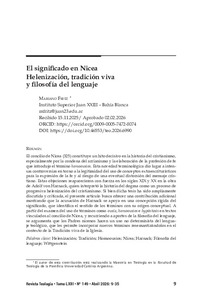 View/Open |

Este ítem está sujeto a una Licencia Creative Commons
