
Please use this identifier to cite or link to this item:
https://repositorio.uca.edu.ar/handle/123456789/22402| Título: | Enamorar con la divinidad de Cristo: la fe de Nicea y la mentalidad histórica en la teología pastoral Falling in Love with the Divinity of Christ: The Faith of Nicaea and Historical Thinking in Pastoral Theology |
Autor: | Forcat, Fabricio | Palabras clave: | TEOLOGIA PASTORAL; FE; Tomás de Aquino, Santo, 1225?-1274 | Fecha de publicación: | 2026 | Editorial: | Pontificia Universidad Católica Argentina. Facultad de Teología | Resumen: | Este artículo asume la tensión pastoral en la transmisión de la fe. La remembranza
de la fórmula nicena de homoousios ofrece la ocasión para una relectura de algunas claves teologales de Santo Tomás de Aquino con la conciencia histórica y la
perspectiva intercultural que propone Bernard Lonergan. La tensión entre reducir
la fe a un mero asentimiento proposicional y disolverla en una experiencia subjetiva carente de densidad dogmática exige superar la des-jerarquización entre el acto
de creer (actus credentis) y las declaraciones de la fe (enuntiabilia). En tres momentos
interdependientes el texto aborda primero, la distinción tomista entre el acto de fe
y su formulación conceptual; segundo, la jerarquía de la ley nueva, donde la gracia
del Espíritu Santo es el elemento principal (potisumum) que dispone el afecto, muy
por encima de los preceptos y las formulaciones; y tercero, la diferenciación de la
conciencia de Lonergan, que permite discernir el tipo apropiado de comunicación
religiosa para cada contexto cultural. La articulación propuesta provoca a que la
teología pastoral sea capaz de “enamorar con la divinidad de Cristo”, evitando tanto el positivismo doctrinal como el subjetivismo emocional, en un ejercicio sinodal
de inculturación y actualización de la tradición. This article addresses the pastoral tension in the transmission of faith. Recalling the Nicene formula of homoousios provides an opportunity to reread some of the theological keys of St. Thomas Aquinas through the historical awareness and intercultural perspective proposed by Bernard Lonergan. The tension between reducing faith to mere propositional assent and dissolving it into a subjective experience lacking dogmatic depth requires overcoming the disjointed hierarchy between the act of believing (actus credentis) and declarations of faith (enuntiabilia). In three interdependent sections, the text addresses, first, the Thomistic distinction between the act of faith and its conceptual formulation; second, the hierarchy of the New Law, where the grace of the Holy Spirit is the principal element (potisumum) that governs the affection, far above precepts and formulations; and third, Lonergan’s differentiation of consciousness, which allows us to discern the appropriate type of religious communication for each cultural context. The proposed articulation enables pastoral theology to “enchant with the divinity of Christ”, avoiding both doctrinal positivism and emotional subjectivism, in a synodal exercise of inculturation and updating of tradition. |
URI: | https://repositorio.uca.edu.ar/handle/123456789/22402 | ISSN: | 2683-7307 (online) 0328-1396 (papel) |
DOI: | 10.46553/teo.2026.7147 | Derechos: | Atribución-NoComercial-CompartirIgual 4.0 Internacional | Fuente: | Teología. Tomo 63, No. 150, 2026 |
| Appears in Collections: | TEO - 2026 Tomo LXIII nro. 150 |
Files in This Item:
| File | Description | Size | Format | |
|---|---|---|---|---|
| enamorar-divinidad-mentalidad.pdf | 429,08 kB | Adobe PDF | 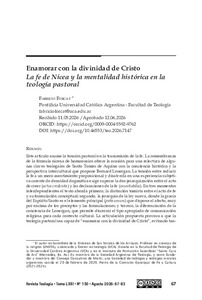 View/Open |

This item is licensed under a Creative Commons License
