
Por favor, use este identificador para citar o enlazar este ítem:
https://repositorio.uca.edu.ar/handle/123456789/22388| Título: | De la religión interior a la reforma de la Iglesia La transformación de la religiosidad durante la Baja Edad Media From Inner Religion to Church Reform: The Transformation of Religiosity in the Late Middle Ages |
Autor: | Tavelli, Federico | Palabras clave: | EDAD MEDIA; RELIGIOSIDAD; CRISTIANISMO; MISTICA | Fecha de publicación: | 2025 | Editorial: | Pontificia Universidad Católica Argentina. Facultad de Teología | Resumen: | Este artículo analiza la transformación de la religiosidad cristiana entre la Baja
Edad Media y la Edad Moderna, enfocándose en el período que abarca del siglo
XIV al XVI en Europa y América. Durante la Edad Media, la concepción de lo sa-
grado evolucionó desde una valoración de la sacralidad de la naturaleza hacia una
apreciación creciente de la sacralidad del ser humano. Hacia el final de este proce-
so, se observa un giro hacia una religiosidad basada en la interioridad individual,
cada vez más independiente de las instancias tradicionales de mediación, como el
clero. Surge así una nueva espiritualidad que exalta los aspectos sensibles y emo-
cionales del ser humano, favoreciendo el desarrollo de corrientes místicas y dando
mayor protagonismo al laicado. Las estructuras eclesiásticas tradicionales dejan de
ser percibidas como los únicos canales de mediación, y el individuo encuentra en
su interioridad la libertad de relacionarse con Dios de manera personal. El tema de
la reforma de la Iglesia se convierte en un punto central de discusión no solo en
Europa, sino también en América. Durante el siglo XVI, los primeros misioneros
franciscanos en México vieron la posibilidad de fundar una «nueva Iglesia» que
aportara a la reforma de la Iglesia universal. This article analyses the transformation of Christian religiosity between the Late Middle Ages and the Early Modern Period, focusing on the 14th to 16th centuries in Europe and America. Throughout the Middle Ages, the concept of the sacred evolved from a valuation of the sacredness of nature to a growing appreciation of the sacredness of the human being. Toward the end of this process, a shift toward a religiosity based on individual interiority becomes evident, increasingly inde- pendent of traditional mediating institutions such as the clergy. This gives rise to a new spirituality that exalts the sensitive and emotional aspects of the human being, fostering the development of mystical currents and granting greater prominence to the laity. Traditional ecclesiastical structures cease to be perceived as the sole chan- nels of mediation, and the individual finds within their interiority the freedom to relate to God in a personal way. The issue of Church reform becomes a central point of discussion not only in Europe but also in America. In the 16th century, the first Franciscan missionaries in México saw the possibility of founding a «new Church» that would contribute to the reform of the universal Church. |
URI: | https://repositorio.uca.edu.ar/handle/123456789/22388 | ISSN: | 2683-7307 (online) 0328-1396 (papel) |
DOI: | 10.46553/teo.62.148.2025.p141-173 | Derechos: | Atribución-NoComercial-CompartirIgual 4.0 Internacional | Fuente: | Teología. Tomo 62, No. 148, 2025 |
| Aparece en las colecciones: | TEO - 2025 Tomo LXII nro. 148 |
Ficheros en este ítem:
| Fichero | Descripción | Tamaño | Formato | |
|---|---|---|---|---|
| religion-transformacion-religiosidad.pdf | 532,67 kB | Adobe PDF | 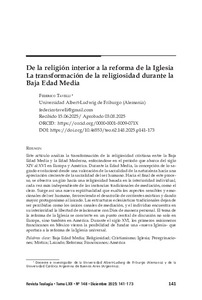 Visualizar/Abrir |

Este ítem está sujeto a una Licencia Creative Commons
