
Por favor, use este identificador para citar o enlazar este ítem:
https://repositorio.uca.edu.ar/handle/123456789/22331| Título: | Liberalismo del justo medio y liberalismo de avanzada: lecturas en contrapunto sobre la democracia decimonónica y sus desafíos The liberalism of the middle ground and progressive liberalism: Contrasting readings of nineteenth-century democracy and its challenge |
Autor: | Pollitzer, María | Palabras clave: | PLURALISMO; GOBIERNO; LIBERTAD; GOBIERNO REPRESENTATIVO | Fecha de publicación: | 2026 | Editorial: | Pontificia Universidad Católica Argentina. Facultad de Ciencias Económicas. Centro de Estudios en Economía y Cultura | Resumen: | Este artículo analiza el pensamiento político de François Guizot y John Stuart
Mill, figuras centrales del liberalismo decimonónico, a través de un ejercicio de lectura en
contrapunto. El estudio identifica que, mientras Guizot buscaba clausurar la Revolución
Francesa mediante un 'liberalismo del justo medio' capaz de conciliar orden y libertad, Mill
advertía sobre el peligro que suponía un horizonte de estancamiento e inmovilidad para
las sociedades modernas. A partir de sus diagnósticos y posicionamientos respecto de la
diversidad, la soberanía y la representación, el trabajo revela algunas de las tensiones
internas de la tradición liberal. Se concluye que el antagonismo sistemático defendido por
Mill y la búsqueda de una aristocracia de la razón y un gobierno moderado en Guizot
representan dos modulaciones críticas —una de conservación y otra de avanzada— frente
a los desafíos de la naciente sociedad democrática. This article analyzes the political thought of François Guizot and John Stuart Mill, key figures of nineteenth-century liberalism, through a comparative reading exercise. The study identifies that, while Guizot sought to close the French Revolution by means of a "juste milieu liberalism" capable of reconciling order and liberty, Mill warned about the dangers that a horizon of stagnation and immobility posed to modern societies. Based on their diagnoses and positions regarding diversity, sovereignty, and representation, the work reveals some of the internal tensions within the liberal tradition. It concludes that the systematic antagonism defended by Mill and the search for anaristocracy of reason and a moderated government in Guizot represent two critical modulations, one conservative and the other progressive, addressing the challenges of the emerging democratic society. |
URI: | https://repositorio.uca.edu.ar/handle/123456789/22331 | ISSN: | 1852-5342 | DOI: | 10.46553/cecon.44.111.2026.p53-68 | Derechos: | Atribución-NoComercial-CompartirIgual 4.0 Internacional | Fuente: | Revista Cultura Económica. 2026, 44(111) |
| Aparece en las colecciones: | CECON - 2026 Año XLIV nro. 111 |
Ficheros en este ítem:
| Fichero | Descripción | Tamaño | Formato | |
|---|---|---|---|---|
| liberalismo-contrapunto-democracia.pdf | 319,63 kB | Adobe PDF | 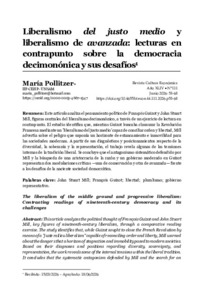 Visualizar/Abrir |

Este ítem está sujeto a una Licencia Creative Commons
