
Por favor, use este identificador para citar o enlazar este ítem:
https://repositorio.uca.edu.ar/handle/123456789/21927| Título: | Why do psychology students believe in neuromyths? A study of personality, contextual and cognitive predictors | Autor: | Tabullo, Ángel Javier | Palabras clave: | NEUROCIENCIA; NEUROMITOS; PSICOLOGIA; ANALISIS | Fecha de publicación: | 2026 | Editorial: | Elsevier | Resumen: | Background: Neuromyths—misconceptions arising from misinterpretations of neuroscientific findings—are widely endorsed by educators and students, including those in psychology. Their persistence has been linked to contextual, cognitive, and personality-related factors, but evidence is mixed, especially among psychology students. This study examined predictors of neuromyth endorsement in Argentine psychology undergraduates. Objective: To identify contextual (neuroscience training, interest), personality (Need for Cognition; NFC), and cognitive (Cognitive Reflection Test; CRT) predictors of neuromyth beliefs. Methods: A convenience sample of 320 psychology students (82.5% women; M_age = 27.39 years) completed online measures assessing neuromyth endorsement, general brain knowledge, NFC, CRT, and self-reported neuroscience training and interest. Spearman correlations and hierarchical regressions were conducted to examine associations and predictive effects. Results: Participants endorsed 41.22% of neuromyths on average, with learning styles (76.25%) and sensory-rich environments benefits (74.37%) being the most accepted. CRT scores negatively predicted neuromyth endorsement (β = 0.175, p < .001), whereas the NFC “enjoyment of thinking” factor positively predicted endorsement (β = 0.145, p = .024). Age also showed a positive effect (β = 0.175, p = .002). Neuroscience interest, courses taken, and general brain knowledge did not predict neuromyth acceptance, although they were positively associated with neuroscience knowledge. Conclusions: Analytical thinking emerged as the strongest protective factor against neuromyths, while enjoyment of thinking unexpectedly predicted higher endorsement, possibly reflecting exposure to low-quality sources of information and/or Dunning-Kruger effects. Factual neuroscience knowledge and training did not decrease neuromyth endorsement, underscoring the importance of fostering critical thinking skills within psychology education. | URI: | https://repositorio.uca.edu.ar/handle/123456789/21927 | ISSN: | 2211-9493 | DOI: | https://doi.org/10.1016/j.tine.2026.100284 | Derechos: | Atribución-NoComercial-CompartirIgual 4.0 Internacional | Fuente: | Trends in Neuroscience and Education. 43, 2026 |
| Aparece en las colecciones: | Artículos |
Ficheros en este ítem:
| Fichero | Descripción | Tamaño | Formato | Login |
|---|---|---|---|---|
| why-psychology-students.pdf | 573,25 kB | Adobe PDF | 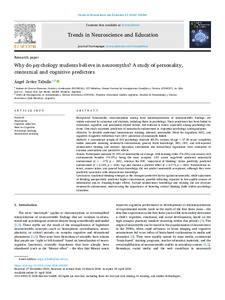 SOLICITAR ACCESO |

Este ítem está sujeto a una Licencia Creative Commons
