
Por favor, use este identificador para citar o enlazar este ítem:
https://repositorio.uca.edu.ar/handle/123456789/21779| Título: | “Sentimos que algo no andaba bien”. Neoliberalismo, daño colateral y malestar en tres cuentos de Diego Zúñiga “We felt that something was not right”. Neoliberalism, Collateral Damage, and Discontent in Three of Diego Zúñiga’s Short Stories |
Autor: | Araya Alarcón, René | Palabras clave: | NEOLIBERALISMO; LITERATURA CHILENA; CHILE; MALESTAR SOCIAL; Zuñiga, Diego | Fecha de publicación: | 2025 | Editorial: | Pontificia Universidad Católica Argentina. Facultad de Filosofía y Letras | Resumen: | Este artículo propone una lectura de tres cuentos del volumen Niños héroes (2016)
de Diego Zúñiga —“La ciudad de los niños”, “Un mundo de cosas frías” y “Cabezas negras”—
desde la hipótesis de que sus protagonistas encarnan subjetividades configuradas como “víctimas
colaterales” del modelo neoliberal chileno. El análisis se organiza en tres niveles: el plano
individual, donde se observan vidas precarizadas; el institucional y espacial, que expone la
desigualdad educativa y urbana; y el relacional-afectivo, donde los vínculos aparecen truncos o
mercantilizados. Desde la perspectiva de Zygmunt Bauman, los relatos evidencian la fragilidad
líquida de horizontes vitales reducidos a la sobrevivencia, mientras que, con Rita Laura Segato,
se comprende cómo operan pedagogías de la crueldad que convierten la exclusión en destino. Así,
Zúñiga articula una representación literaria crítica que da cuenta del malestar social y cultural
que desembocaría en el estallido chileno de 2019. This article offers a reading of three short stories from Diego Zúñiga’s Niños héroes (2016) —“La ciudad de los niños,” “Un mundo de cosas frías,” and “Cabezas negras”— based on the hypothesis that their protagonists embody subjectivities shaped as “collateral victims” of the Chilean neoliberal model. The analysis is structured around three levels: the individual level, where precarious lives are portrayed; the institutional and spatial level, which exposes educational and urban inequality; and the relational-affective level, where bonds appear fractured or commodified. Drawing on Zygmunt Bauman, the stories reveal the liquid fragility of life horizons reduced to mere survival, while with Rita Laura Segato they illustrate how pedagogies of cruelty operate by turning exclusion into destiny. In this way, Zúñiga constructs a critical literary representation that reflects the social and cultural unrest that would culminate in Chile’s 2019 uprising. |
URI: | https://repositorio.uca.edu.ar/handle/123456789/21779 | ISSN: | 0326-3363 2683-7897 |
Derechos: | Atribución-NoComercial-CompartirIgual 4.0 Internacional | Fuente: | Letras 2025(92) |
| Appears in Collections: | LETRAS - 2025 nro. 92 |
Files in This Item:
| File | Description | Size | Format | |
|---|---|---|---|---|
| sentimos-neoliberalismo-Zúñiga.PDF | 496,26 kB | Adobe PDF | 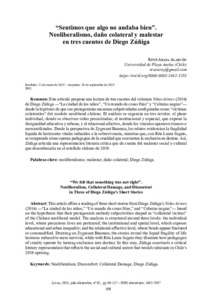 View/Open |

This item is licensed under a Creative Commons License
