
Please use this identifier to cite or link to this item:
https://repositorio.uca.edu.ar/handle/123456789/21744| Título: | No seré el padre Castañeda del año 20, seré el padre Castañeta del año 52. "Prensa burlesca en la Buenos Aires Post-Caseros I Will Not Be Father Castañeda of ’20, I Will Be Father Castañeta of ’52". Burlesque Press in Post-Caseros Buenos Aires | Autor: | Herrero, Fabián | Palabras clave: | PRENSA; CASEROS; BUENOS AIRES. CIUDAD; POLITICA | Fecha de publicación: | 2025 | Editorial: | Pontificia Universidad Católica Argentina. Facultad de Derecho y Ciencias Sociales del Rosario. Instituto de Historia | Resumen: | El Padre Castañeta forma parte de la prensa burlesca de Buenos Aires que surge luego de Caseros. Los
estudios generales del período lo mencionan. Sin embargo, no hay aún trabajos que lo analicen de forma particular.
Este articulo examina aspectos relativos a su surgimiento y a sus integrantes. Me propongo mostrar que se trata de
un periódico que evoca la figura del escritor Francisco Castañeda, no de manera retórica, sino que lo hace de un
modo en el que intenta tomar algunos aspectos de aquella experiencia publica desarrollada durante el año y la
década de 1820. Esa apelación a su figura justifica, por cierto, algunos aspectos de su estrategia periodística.
Postulo también que sus integrantes tienen una experiencia pública previa en el final del rosismo y que de ella
surgen algunos ingredientes que continúan en su práctica periodística posterior a Caseros. A modo de hipótesis,
este trabajo pretende mostrar que Caseros, desde la perspectiva de la prensa por lo menos, no constituye un parte
aguas marcado. En el mundo periodístico se presentan, en varios casos, una suerte de línea de continuidad en el
cambio. Por este motivo, se advierten movimientos de adaptación y escrituras que sobreactúan de algún mo do su
rechazo al rosismo. Padre Castañeda is part of the Buenos Aires burlesque press that emerged after Caseros. General studies of the period mention it. However, there are no works that analyze it specifically. This article examines aspects related to its emergence and its members. I propose to show that it is a newspaper that evokes the figure of the writer Francisco Castañeda, not rhetorically, but rather in a way that attempts to draw on some aspects of that public experience developed during the 1820s and the 1820s. This appeal to his figure certainly justifies some aspects of its journalistic strategy. I also postulate that its members had prior public experience at the end of the Rosismo era and that from it emerged some elements that continue in their journalistic practice after Caseros. As a hypothesis, this work aims to show that Caseros, at least from the perspective of the press, does not constitute a marked watershed. In the journalistic world, in several cases, a sort of line of continuity in change is presented. For this reason, there are movements of adaptation and writings that somewhat overact their rejection of Rosismo. |
URI: | https://repositorio.uca.edu.ar/handle/123456789/21744 | ISSN: | 2525-0884 (online) 0325-772X (impreso) |
DOI: | 10.46553/RGES.61.2025.p102-122 | Derechos: | Atribución-NoComercial-CompartirIgual 4.0 Internacional | Fuente: | Res Gesta. 2025(61) |
| Appears in Collections: | RG - 2025 nro. 61 |
Files in This Item:
| File | Description | Size | Format | |
|---|---|---|---|---|
| padre-prensa-burlesca.pdf | 468,51 kB | Adobe PDF | 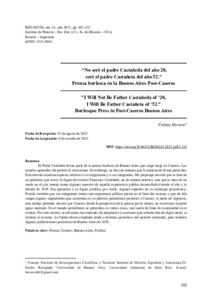 View/Open |

This item is licensed under a Creative Commons License
