
Please use this identifier to cite or link to this item:
https://repositorio.uca.edu.ar/handle/123456789/21735| Título: | Constelando la noción de ciudad-puerto: Echeverría, Weber y el desarrollo territorial periférico Constellating the Notion of the Port City: Echeverría, Weber, and Peripheral Territorial Development |
Autor: | Cozzi, Juan Manuel Sejas, Nicolás Ojalvo, Felipe |
Palabras clave: | DESARROLLISMO; CIUDAD; PUERTOS; Echeverría, Esteban, 1805-1851 | Fecha de publicación: | 2025 | Editorial: | Pontificia Universidad Católica Argentina. Facultad de Derecho y Ciencias Sociales del Rosario. Instituto de Historia | Resumen: | Este trabajo explora un cruce analítico entre Esteban Echeverría, Max Weber y la teoría del desarrollismo
a partir de sus respectivas reflexiones sobre la economía ganadera, el comercio exterior y la organización territorial
de la periferia. El objetivo no es establecer una filiación directa entre los autores y las corrientes, sino reconstruir
un campo de problemas compartido que permita iluminar los procesos de inserción subordinada de los espacios
periféricos en el mercado mundial. A partir del análisis de un texto poco frecuentado de Weber —su estudio sobre
los trabajadores rurales de Entre Ríos— y de fragmentos de la Segunda lectura a la Asociación de Mayo de
Echeverría, el artículo indaga cómo elementos como la tierra, el ganado, el trabajo y la exportación adquieren
centralidad en sus diagnósticos. En ese marco, se propone una lectura relacional de la categoría de ciudad-puerto,
no como objeto crítico, sino como figura conceptual cuya emergencia puede ser pensada en diálogo con estos
antecedentes. This work explores an analytical intersection between Esteban Echeverría, Max Weber, and developmentalist theory, based on their respective reflections on the livestock economy, foreign trade, and the territorial organization of the periphery. The aim is not to establish a direct lineage between these authors and traditions, but rather to reconstruct a shared field of inquiry that sheds light on the processes of subordinate integration of peripheral spaces into the global market. Through an analysis of a seldom-examined text by Weber —his study on rural workers in Entre Ríos— and fragments from Echeverría’s Segunda lectura a la Asociación de Mayo, the article investigates how elements such as land, livestock, labor, and exports become central to their diagnoses. Within this framework, it proposes a relational reading of the port-city category —not as a critical object, but as a conceptual figure whose emergence can be understood in dialogue with these antecedents. |
URI: | https://repositorio.uca.edu.ar/handle/123456789/21735 | ISSN: | 2525-0884 (online) 0325-772X (impreso) |
DOI: | 10.46553/RGES.61.2025.p29-48 | Derechos: | Atribución-NoComercial-CompartirIgual 4.0 Internacional | Fuente: | Res Gesta. 2025(61) |
| Appears in Collections: | RG - 2025 nro. 61 |
Files in This Item:
| File | Description | Size | Format | |
|---|---|---|---|---|
| constelando-desarrollo-periférico.pdf | 530,7 kB | Adobe PDF | 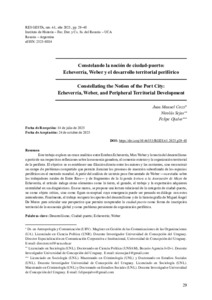 View/Open |

This item is licensed under a Creative Commons License
