
Por favor, use este identificador para citar o enlazar este ítem:
https://repositorio.uca.edu.ar/handle/123456789/21583| Título: | The final years of the triumvirate:power dynamics and the role of octavian's architecture in political messaging Los últimos años del Triunvirato:Dinámicas de poder y la arquitectura de Octavio como herramienta de mensaje político |
Autor: | López Gómez, Helena | Palabras clave: | Augusto, Emperador de Roma, 63 a. C.-14 d. C.; PRINCIPADO; MAUSOLEO; POLITICA | Fecha de publicación: | 2024 | Editorial: | Pontificia Universidad Católica Argentina. Facultad de Ciencias Sociales. Departamento de Historia. Programa de Estudios Históricos Grecorromanos | Resumen: | The primary objective of this paper is to offer an interpretation of the
relationship between architectural monuments and the political atmosphere during
the years of the Second Triumvirate and the moments immediately following. It
will also offer a synthesis of the different theories on the significance of Octavian’s
architecture in this period. During the years 32-27 BCE, Octavian’s constitutional
position was outside the law, but this situation was legitimised by the oath of
allegiance proclaimed in 32 BCE. This political instability characterised a period
dominated by the ongoing struggle against Mark Antony. The position of supreme
power, constitutional uncertainty and civil war can be perceived by analysing the
monuments of this period, including the Mausoleum and the Temple of Apollo
Palatine. La intención principal de este trabajo es la de ofrecer una interpretación sobre la vinculación entre monumentos arquitectónicos y atmósfera política en los años del Segundo Triunvirato y los momentos inmediatamente posteriores. Con estaintención también se ofrecerá una síntesis sobre las distintas teorías acerca del significado de la arquitectura de Octavio en este periodo. Entre el 32 y el 27 a.C. la posición constitucional de Octavio estuvo fuera de la ley, sin embargo, esta situación fue legitimada a través del juramento de lealtad pronunciado en el 32 a.C. Esta inestabilidad política fue la tónica de un periodo dominado por la lucha contra Marco Antonio. La posición de poder supremo, la incerteza constitucional y la guerra civil pueden ser percibidos al analizar los monumentos de este periodo: el Mausoleo y el templo de Apolo Palatino. |
URI: | https://repositorio.uca.edu.ar/handle/123456789/21583 | ISSN: | 2250-4923 | Derechos: | Atribución-NoComercial-CompartirIgual 4.0 Internacional | Fuente: | De Rebus Antiquis. 2024, 12 |
| Aparece en las colecciones: | DRA - 2024 nro. 12 |
Ficheros en este ítem:
| Fichero | Descripción | Tamaño | Formato | |
|---|---|---|---|---|
| years-power-role.pdf | 644,44 kB | Adobe PDF | 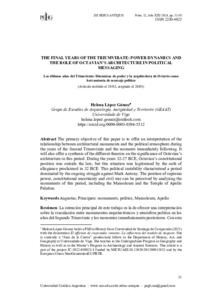 Visualizar/Abrir |

Este ítem está sujeto a una Licencia Creative Commons
