
Por favor, use este identificador para citar o enlazar este ítem:
https://repositorio.uca.edu.ar/handle/123456789/6859| Campo DC | Valor | Lengua/Idioma |
|---|---|---|
| dc.contributor.author | Ohanessian, Fernando | es |
| dc.date.accessioned | 2019-06-19T23:38:38Z | - |
| dc.date.available | 2019-06-19T23:38:38Z | - |
| dc.date.issued | 2008 | - |
| dc.identifier.citation | Ohanessian, F. El think tank “Proyecto para el nuevo siglo estadounidense”, el sistema internacional y el caso Irak [en línea]. Colección. 2008, 18-19. Disponible en: https://repositorio.uca.edu.ar/handle/123456789/6859 | es |
| dc.identifier.issn | 1850 003X (en linea) | - |
| dc.identifier.issn | 0328 7998 (impreso) | - |
| dc.identifier.uri | https://repositorio.uca.edu.ar/handle/123456789/6859 | - |
| dc.description.abstract | Resumen: Todo el espectro político estadounidense está representado por centros de investigación y análisis de políticas públicas, que pujan por la interpretación de los acontecimientos y por preparar (a su imagen) el escenario de los hechos por venir. Este trabajo toma por caso el think tank conocido como The project for the New American Century (PNAC), a los efectos de analizar su postura (cosmovisión) y su modo de influencia sobre la percepción de sus usuarios, tanto con respecto al sistema internacional en general como con los cursos de acción posibles relacionados con el tema Irak en particular. A tal fin se abordan, primero, como fundamento teórico, conceptos claves del Sistema Internacional. Luego, se caracteriza el mencionado think tank: quiénes son, su sitio web, objetivos autoproclamados y parte de su producción dedicada al conflicto en Irak. Finalmente, se relaciona dicha caracterización con el mencionado conflicto y el Sistema Internacional. | es |
| dc.description.abstract | Abstract: All the American political specter is represented by centers for research and public policies analysis, called think tank. They push forward for the interpretation of the present political events and for the manipulation of the futures ones. This paper considers the think tank called Project for the New American Century (PNAC), with the purpose of examining the posture and the way that it influences the public perception, in relation to the international system in general, and the policies on the Iraqi conflict in particular. Therefore, the document takes up, in first place, theoretical key concepts of the international system. Then, it uncovers the above mentioned think tank (who they are, their website, statements, and their intellectual production related to Iraq). At last, the article connects the PNAC characterization with the International system and with the aforementioned conflict. | es |
| dc.format | application/pdf | es |
| dc.language.iso | spa | es |
| dc.publisher | Pontificia Universidad Católica Argentina. Facultad de Ciencias Sociales. Departamento de Ciencias Políticas y Relaciones Internacionales | es |
| dc.rights | Acceso Abierto | es |
| dc.rights.uri | https://creativecommons.org/licenses/by-nc-sa/4.0/ | es |
| dc.source | Colección. 2008, 18-19 | es |
| dc.subject | Estados Unidos | es |
| dc.subject | GRUPOS DE PRESION | es |
| dc.subject | POLITICAS PUBLICAS | es |
| dc.subject | IRAK | es |
| dc.subject | POLITICA INTERNACIONAL | es |
| dc.subject | RELACIONES INTERNACIONALES | es |
| dc.title | El think tank “Proyecto para el nuevo siglo estadounidense”, el sistema internacional y el caso Irak | es |
| dc.type | Artículo | es |
| uca.path | Colección|2008 Año XIII-XIV nº 18-19 | es |
| uca.disciplina | CIENCIA POLITICA | es |
| uca.filename | /home/data-uca-generic/folder_revistas/Revistas varias/coleccion/coleccion18-19/think-tank-proyecto-nuevo/metadata.xml | es |
| uca.issnrd | 1 | es |
| uca.affiliation | Fil: Ohanessian, Fernando. Pontificia Universidad Católica Argentina; Argentina | es |
| uca.affiliation | Fil: Ohanessian, Fernando. Escuela de Defensa Nacional; Argentina | es |
| uca.affiliation | Fil: Ohanessian, Fernando. Escuela Superior de Guerra Conjunta; Argentina | es |
| uca.orden | 05 | es |
| uca.version | publishedVersion | es |
| item.grantfulltext | open | - |
| item.languageiso639-1 | es | - |
| item.fulltext | With Fulltext | - |
| Aparece en las colecciones: | COL - 2008 Año XIII-XIV nro. 18-19 | |
Ficheros en este ítem:
| Fichero | Descripción | Tamaño | Formato | |
|---|---|---|---|---|
| 810-2686-1-PB.pdf | 111,45 kB | Adobe PDF | 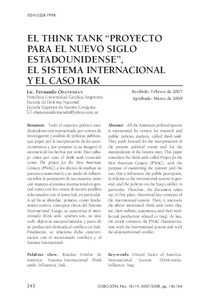 Visualizar/Abrir |
Visualizaciones de página(s)
119
comprobado en 30-abr-2024
Descarga(s)
89
comprobado en 30-abr-2024

Google ScholarTM
Ver en Google Scholar
Este ítem está sujeto a una Licencia Creative Commons
