
Por favor, use este identificador para citar o enlazar este ítem:
https://repositorio.uca.edu.ar/handle/123456789/22403| Campo DC | Valor | Lengua/Idioma |
|---|---|---|
| dc.contributor.author | Bianchi, Enrique Ciro | es |
| dc.date.accessioned | 2026-09-17T19:09:01Z | - |
| dc.date.available | 2026-09-17T19:09:01Z | - |
| dc.date.issued | 2026 | - |
| dc.identifier.issn | 2683-7307 (online) | - |
| dc.identifier.issn | 0328-1396 (papel) | - |
| dc.identifier.uri | https://repositorio.uca.edu.ar/handle/123456789/22403 | - |
| dc.description.abstract | El artículo conmemora los cincuenta años de Evangelii Nuntiandi (1975) evaluando su vigencia como documento programático del posconcilio. Se presenta el contexto del Sínodo de 1974, marcado por las tensiones entre evangelización y liberación sociopolítica en el marco de la recepción conciliar latinoamericana, con especial atención al aporte decisivo de Eduardo Pironio y la reflexión de la COEPAL en la génesis del documento. Se analiza el planteo central de la exhortación: la categoría amplia de evangelización como horizonte integrador de toda la acción eclesial, su teología de la inculturación y la superación de la falsa antinomia entre anuncio del Evangelio y promoción humana. Se traza luego la recepción del documento en el magisterio latinoamericano –Puebla, Juan Pablo II, Aparecida, Evangelii Gaudium– y su influjo en el pensamiento de Lucio Gera y Rafael Tello, mostrando el hilo conductor que va de la reflexión argentina del posconcilio hasta Dilexi te de León XIV. Finalmente, se sostiene que la actualidad de Evangelii Nuntiandi radica en su capacidad de ofrecer no una fórmula cerrada, sino una brújula hermenéutica para discernir, en cada contexto histórico, la relación entre fe y compromiso con la historia. | es |
| dc.description.abstract | This article commemorates the fiftieth anniversary of Evangelii Nuntiandi (1975), assessing its enduring relevance as a programmatic document of the post-conciliar period. It presents the context of the 1974 Synod, marked by the tensions between evangelization and sociopolitical liberation within the Latin American reception of the Council, with particular attention to the decisive contribution of Eduardo Pironio and the reflection of COEPAL in the document’s genesis. It then analyzes the exhortation’s central argument: the broad notion of evangelization as an integrating horizon for all ecclesial action, its theology of inculturation, and its overcoming of the false antinomy between the proclamation of the Gospel and human advancement. The article then traces the document’s reception in the Latin American magisterium —Puebla, John Paul II, Aparecida, Evangelii Gaudium— and its influence on the thought of Lucio Gera and Rafael Tello, showing the common thread running from Argentine post-conciliar reflection to Dilexi te of Leo XIV. Finally, it argues that the relevance of Evangelii Nuntiandi lies in its capacity to offer not a closed formula but a hermeneutical compass for discerning, in each historical context, the relationship between faith and commitment to history. | es |
| dc.format | application/pdf | es |
| dc.language.iso | spa | es |
| dc.publisher | Pontificia Universidad Católica Argentina. Facultad de Teología | es |
| dc.rights | Atribución-NoComercial-CompartirIgual 4.0 Internacional | * |
| dc.rights.uri | http://creativecommons.org/licenses/by-nc-sa/4.0/ | * |
| dc.source | Teología. Tomo 63, No. 150, 2026 | es |
| dc.subject | EVANGELIZACION | es |
| dc.subject | LIBERALIZACION | es |
| dc.subject | TEOLOGIA LATINOAMERICANA | es |
| dc.title | Evangelii Nuntiandi, una estrella que aún arroja luz | es |
| dc.title | Evangelii Nuntiandi: A Star That Still Sheds Light | es |
| dc.type | Artículo | es |
| dc.identifier.doi | 10.46553/teo.2026.7121 | - |
| uca.issnrd | 1 | es |
| uca.affiliation | Fil: Bianchi, Enrique Ciro. Pontificia Universidad Católica Argentina; Argentina | es |
| uca.version | publishedVersion | es |
| item.fulltext | With Fulltext | - |
| item.grantfulltext | open | - |
| item.languageiso639-1 | es | - |
| Aparece en las colecciones: | TEO - 2026 Tomo LXIII nro. 150 | |
Ficheros en este ítem:
| Fichero | Descripción | Tamaño | Formato | |
|---|---|---|---|---|
| estrella-arroja-luz.pdf | 376,77 kB | Adobe PDF | 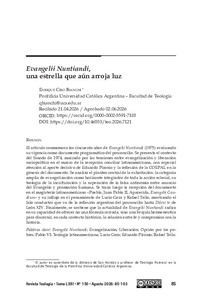 Visualizar/Abrir |

Este ítem está sujeto a una Licencia Creative Commons
