
Por favor, use este identificador para citar o enlazar este ítem:
https://repositorio.uca.edu.ar/handle/123456789/22385| Campo DC | Valor | Lengua/Idioma |
|---|---|---|
| dc.contributor.author | Bertolini, Alejandro | es |
| dc.date.accessioned | 2026-09-17T18:24:54Z | - |
| dc.date.available | 2026-09-17T18:24:54Z | - |
| dc.date.issued | 2025 | - |
| dc.identifier.issn | 2683-7307 (online) | - |
| dc.identifier.issn | 0328-1396 (papel) | - |
| dc.identifier.uri | https://repositorio.uca.edu.ar/handle/123456789/22385 | - |
| dc.description.abstract | El concilio de Nicea canonizó la consubstancialidad de la persona del Hijo con la Padre, y con esta aseveración puso las bases para entender el verdadero arraigo del hombre, su auténtico origen y destino. Sin embargo, el impacto de su declinación antropológica es poco explorado. En este breve artículo, exploraremos tres posibles líneas de comprensión de semejante revolución del pensamiento originada en el 325. En primer lugar, exploraremos la alteridad en Dios como núcleo constituti vo de lo sagrado. Luego abordaremos el valor de la carne como encuentro con la alteridad que salva para finalmente dedicar unas palabras a la divinización como único destino de plenitud humana. | es |
| dc.description.abstract | The Council of Nicaea canonized the consubstantiality of the person of the Son with the Father, and with this assertion laid the foundation for understanding the true rootedness of man, his authentic origin and destiny. However, the impact of its anthropological decline is little explored. In this brief article, we will explore three possible lines of understanding of such a revolution in thought that began in 325. First, we will explore otherness in God as the constitutive core of the sacred. Then, we will address the value of the flesh as an encounter with the otherness that saves, and finally, we will dedicate a few words to divinization as the sole destiny of human fulfillment. | es |
| dc.format | application/pdf | es |
| dc.language.iso | spa | es |
| dc.publisher | Pontificia Universidad Católica Argentina. Facultad de Teología | es |
| dc.rights | Atribución-NoComercial-CompartirIgual 4.0 Internacional | * |
| dc.rights.uri | http://creativecommons.org/licenses/by-nc-sa/4.0/ | * |
| dc.source | Teología. Tomo 62, No. 148, 2025 | es |
| dc.subject | DIVINIZACION | es |
| dc.subject | ANTROPOLOGIA | es |
| dc.subject | ALTERIDAD | es |
| dc.title | «Nicaenus homo»: Pensar al hombre a la luz de Nicea | es |
| dc.title | «Nicaenus homo»: Thinking about Man in the Light of Nicaea | es |
| dc.type | Artículo | es |
| dc.identifier.doi | 10.46553/teo.62148.2025.p61-70 | - |
| uca.issnrd | 1 | es |
| uca.affiliation | Fil: Bertolini, Alejandro. Pontificia Universidad Católica Argentina; Argentina | es |
| uca.version | publishedVersion | es |
| item.fulltext | With Fulltext | - |
| item.grantfulltext | open | - |
| item.languageiso639-1 | es | - |
| crisitem.author.dept | Facultad de Teología | - |
| crisitem.author.dept | Instituto de Investigaciones Teológicas (ININTE) | - |
| crisitem.author.dept | Grupo de Investigación en Teología Sistemática | - |
| crisitem.author.orcid | 0000-0003-0472-9918 | - |
| crisitem.author.parentorg | Pontificia Universidad Católica Argentina | - |
| crisitem.author.parentorg | Facultad de Teología | - |
| crisitem.author.parentorg | Instituto de Investigaciones Teológicas (ININTE) | - |
| Aparece en las colecciones: | TEO - 2025 Tomo LXII nro. 148 | |
Ficheros en este ítem:
| Fichero | Descripción | Tamaño | Formato | |
|---|---|---|---|---|
| nicaenus-hombre-luz.pdf | 152,25 kB | Adobe PDF | 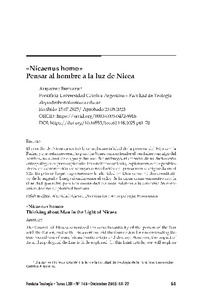 Visualizar/Abrir |

Este ítem está sujeto a una Licencia Creative Commons
