
Por favor, use este identificador para citar o enlazar este ítem:
https://repositorio.uca.edu.ar/handle/123456789/22377| Título: | El nuevo espíritu del capitalismo digital: El giro especulativo de la gubernamentalidad en la era del aprendizaje automático The new spirit of digital capitalism: The speculative turn of gubernamentality in the age of machine learning |
Autor: | Rouvroy, Antoinette Matti, Felipe A. (Trad.) |
Palabras clave: | INTELIGENCIA ARTIFICIAL; CAPITALISMO; POLITICA | Fecha de publicación: | 2026 | Editorial: | Pontificia Universidad Católica Argentina. Facultad de Filosofía y Letras. Centro de Estudiantes de Filosofía | Resumen: | Este trabajo examina la centralidad que ha
adquirido la inteligencia artificial en la gubernamentalidad.
Partiendo de una hipótesis deleuziana, que las máquinas no
determinan las formaciones sociales, sino que las expresan, se
busca aquí dar con el fundamento político y sociocultural, así
como también económico, de este giro especulativo. Se
interroga así el imperativo actual de adopción de sistemas
algorítmicos, que diluye las fronteras entre investigación,
desarrollo y despliegue comercial, al tiempo que reconfigura
prácticas profesionales y regímenes de validación. A través del
prisma metodológico de la gubernamentalidad, el artículo
identifica desplazamientos semióticos, normativos y éticos
característicos de un capitalismo intensificado por lo
algorítmico, denominado “giro especulativo”. En este marco,
las inteligencias artificiales, especialmente en su “primera ola”,
operan como dispositivos de ordenamiento y jerarquización de
deep learning, promovidos como herramientas indispensables
frente a la complejidad y la incertidumbre. El análisis muestra
cómo la convergencia entre transición digital y ecológicatraduce una fe renovada en la capacidad técnica para gestionar
la contingencia, configurando una racionalidad que oscila
entre ideología y creencia. This paper examines the centrality that artificial intelligence has acquired within governmentality. Starting from a Deleuzian hypothesis—that machines do not determine social formations but rather express them—it seeks to identify the political, sociocultural, and economic foundations of this speculative turn. It thus interrogates the current imperative to adopt algorithmic systems, which blurs the boundaries between research, development, and commercial deployment, while simultaneously reconfiguring professional practices and regimes of validation. Through the methodological prism of governmentality, the article identifies semiotic, normative, and ethical shifts characteristic of a form of capitalism intensified by the algorithmic, referred to as the “speculative turn.” Within this framework, artificial intelligences—especially in their “first wave”—operate as devices for ordering and hierarchizing massive datasets, promoted as indispensable tools for dealing with complexity and uncertainty. The analysis shows how the convergence of digital and ecological transitions reflects a renewed faith in technical capacities to manage contingency, configuring a rationality that oscillates between ideology and belief. |
URI: | https://repositorio.uca.edu.ar/handle/123456789/22377 | ISSN: | 2591-572X | DOI: | 10.46553/tab.28.2026.e4 | Derechos: | Atribución-NoComercial-CompartirIgual 4.0 Internacional | Fuente: | Tábano. 2026, 28 |
| Aparece en las colecciones: | TAB - 2026 nro. 28 |
Ficheros en este ítem:
| Fichero | Descripción | Tamaño | Formato | |
|---|---|---|---|---|
| espiritu-capitalismo-aprendizaje.pdf | 1,19 MB | Adobe PDF | 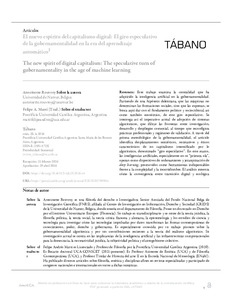 Visualizar/Abrir |

Este ítem está sujeto a una Licencia Creative Commons
