
Por favor, use este identificador para citar o enlazar este ítem:
https://repositorio.uca.edu.ar/handle/123456789/22332| Campo DC | Valor | Lengua/Idioma |
|---|---|---|
| dc.contributor.author | Krause, Martín | es |
| dc.date.accessioned | 2026-09-01T20:46:10Z | - |
| dc.date.available | 2026-09-01T20:46:10Z | - |
| dc.date.issued | 2026 | - |
| dc.identifier.issn | 1852-5342 | - |
| dc.identifier.uri | https://repositorio.uca.edu.ar/handle/123456789/22332 | - |
| dc.description.abstract | El artículo analiza la utopía libertaria como una propuesta de organización social basada en la propiedad privada, los intercambios voluntarios y la ausencia del Estado. Sostiene que una utopía no debe juzgarse por su aplicación actual, sino por su coherencia con la naturaleza humana y los principios de la acción humana. Recorre la evolución de estas ideas desde Gustave de Molinari hasta autores como Murray Rothbard, David Friedman, Ayn Rand y Michael Huemer, quienes exploran cómo podrían proveerse de manera voluntaria la seguridad, la justicia y otros servicios. El trabajo también examina críticas, propuestas de transición y las condiciones necesarias para que una sociedad sin Estado pudiera funcionar. Concluye que, aunque esta visión siga siendo una utopía, constituye un ejercicio intelectual valioso para evaluar instituciones, ampliar los límites de la filosofía política e imaginar posibles formas futuras de organización social. | es |
| dc.description.abstract | The article examines the libertarian utopia as a proposal for social organization based on private property, voluntary exchange, and the absence of the state. It argues that a utopia should not be judged by its current feasibility, but rather by its consistency with human nature and the principles of human action. The paper traces the development of these ideas from Gustave de Molinari to thinkers such as Murray Rothbard, David Friedman, Ayn Rand, and Michael Huemer, who explore how security, justice, and other services could be provided voluntarily. It also examines critiques of the libertarian utopia, proposals for a transition toward such a society, and the conditions necessary for a stateless social order to function. The article concludes that, although this vision remains a utopia, it represents a valuable intellectual exercise for evaluating institutions, expanding the boundaries of political philosophy, and imagining possible future forms of social organization | es |
| dc.format | application/pdf | es |
| dc.language.iso | spa | es |
| dc.publisher | Pontificia Universidad Católica Argentina. Facultad de Ciencias Económicas. Centro de Estudios en Economía y Cultura | es |
| dc.rights | Atribución-NoComercial-CompartirIgual 4.0 Internacional | * |
| dc.rights.uri | http://creativecommons.org/licenses/by-nc-sa/4.0/ | * |
| dc.source | Revista Cultura Económica. 2026, 44(111) | es |
| dc.subject | MERCADOS | es |
| dc.subject | LIBERTARISMO | es |
| dc.subject | ESTADO | es |
| dc.subject | PROPIEDAD PRIVADA | es |
| dc.title | La utopía libertaria: el fin del Estado | es |
| dc.title | The libertarian utopia: The end of the State | es |
| dc.type | Artículo | es |
| dc.identifier.doi | 10.46553/cecon.44.111.2026.p69-91 | - |
| uca.issnrd | 1 | es |
| uca.affiliation | Fil: Krause, Martín. Fundación Faro Argentina; Argentina | es |
| uca.version | publishedVersion | es |
| item.fulltext | With Fulltext | - |
| item.grantfulltext | open | - |
| item.languageiso639-1 | es | - |
| Aparece en las colecciones: | CECON - 2026 Año XLIV nro. 111 | |
Ficheros en este ítem:
| Fichero | Descripción | Tamaño | Formato | |
|---|---|---|---|---|
| utopia-libertaria-estado.pdf | 346,98 kB | Adobe PDF | 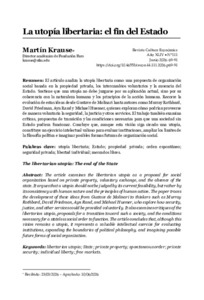 Visualizar/Abrir |

Este ítem está sujeto a una Licencia Creative Commons
