
Por favor, use este identificador para citar o enlazar este ítem:
https://repositorio.uca.edu.ar/handle/123456789/21783| Campo DC | Valor | Lengua/Idioma |
|---|---|---|
| dc.contributor.author | Maveroff, Juan | es |
| dc.date.accessioned | 2026-06-11T12:33:39Z | - |
| dc.date.available | 2026-06-11T12:33:39Z | - |
| dc.date.issued | 2025 | - |
| dc.identifier.issn | 0326-3363 | - |
| dc.identifier.issn | 2683-7897 | - |
| dc.identifier.uri | https://repositorio.uca.edu.ar/handle/123456789/21783 | - |
| dc.description.abstract | El presente artículo explora la intersección entre mal gusto, estigma social y experiencia estética en la novela La casa (1954) de Manuel Mujica Lainez. Se propondrá una lectura de estos tres motivos como pilares de la configuración del mundo de la novela, que denotan un trasfondo hostil y poco propicio al diálogo, tanto entre los habitantes como entre estos y la propia casa, y finalmente desemboca en la extinción de la familia y demolición de la casa. La estructura en racconto de la narración, de modalidad rumiante y que se propone interpretar lo mismo que relata, ofrece al lector un universo trágico en el que el auge de la familia (coincidente con la Generación del 80) sucumbe ante su propia incapacidad de descentrarse y dialogar consigo misma. | es |
| dc.description.abstract | The following article explores the intersection between bad taste, social stigma, and aesthetic experience in Manuel Mujica Lainez’s 1954 novel La casa. An interpretation from the point of view of these three themes will be given as pillars of the fictional world’s configuration, which indicates a hostile background, closed to the possibility of dialogue, both among the members of the family and between the members’ relationship to the house. This finally results in the family’s extinction and the demolition of the house. The ruminating racconto structure of narration, which aims to reflect upon that which narrates, offers to the reader a tragic world in which the heyday of the family (convergent with the argentine Generation of 80’) falls prey to its own incapacity of decentering and discuss with itself. | es |
| dc.format | application/pdf | es |
| dc.language.iso | spa | es |
| dc.publisher | Pontificia Universidad Católica Argentina. Facultad de Filosofía y Letras | es |
| dc.rights | Atribución-NoComercial-CompartirIgual 4.0 Internacional | * |
| dc.rights.uri | http://creativecommons.org/licenses/by-nc-sa/4.0/ | * |
| dc.source | Letras 2025(92) | es |
| dc.subject | ESTETICA LITERARIA | es |
| dc.subject | ESTIGMATIZACION | es |
| dc.subject | FAMILIA | es |
| dc.subject | GUSTO | es |
| dc.title | Mal gusto, estigma y experiencia estética en La casa de Manuel Mujica Lainez | es |
| dc.title | Bad Taste, Stigma and Aesthetic Experience in Manuel Mujica Lainez’s La casa | es |
| dc.type | Artículo | es |
| dc.identifier.doi | 10.46553 | - |
| uca.issnrd | 1 | es |
| uca.affiliation | Fil: Maveroff, Juan. Universidad Católica Argentina; Argentina | es |
| uca.version | publishedVersion | es |
| item.grantfulltext | open | - |
| item.fulltext | With Fulltext | - |
| item.languageiso639-1 | es | - |
| Aparece en las colecciones: | LETRAS - 2025 nro. 92 | |
Ficheros en este ítem:
| Fichero | Descripción | Tamaño | Formato | |
|---|---|---|---|---|
| gusto-estigma-experiencia.pdf | 413,31 kB | Adobe PDF | 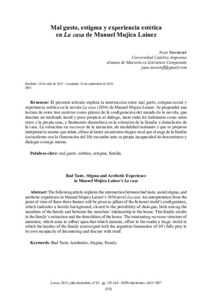 Visualizar/Abrir |

Este ítem está sujeto a una Licencia Creative Commons
