
Por favor, use este identificador para citar o enlazar este ítem:
https://repositorio.uca.edu.ar/handle/123456789/21549| Campo DC | Valor | Lengua/Idioma |
|---|---|---|
| dc.contributor.author | Ariovich, Laura | es |
| dc.contributor.author | Chávez, Molina Eduardo | es |
| dc.contributor.author | Gutiérrez Ageitos, Pablo | es |
| dc.contributor.author | Hadad, Iara | es |
| dc.coverage.spatial | Argentina | es |
| dc.date.accessioned | 2026-05-26T18:30:57Z | - |
| dc.date.available | 2026-05-26T18:30:57Z | - |
| dc.date.issued | 2008 | - |
| dc.identifier.uri | https://repositorio.uca.edu.ar/handle/123456789/21549 | - |
| dc.description.abstract | Scientific paper presented at the ISA-RC02 Midterm Conference "Inequality Beyond Globalization: Economic Changes and the Dynamics of Inequality", held at the University of Neuchâtel, Switzerland - This paper describes the process of social fragmentation and polarization resulting from market-oriented reforms in Argentina in the 1990s. Relying on both qualitative - quantitative data, we focus on the post-layoff trajectories of nonprofessional workers who lost their stable, benefit-carrying jobs at the end of the recession following the 1994 Mexican peso crisis. We examine these workers’ trajectories by two complementary channels. First, we conduct a comparative analysis of reinsertion paths based on two surveys of laid-off workers, one conducted in the mid-1980s and the other in the late 1990s. This analysis shows that, compared to the mid-1980s, the job market in the late 1990s offered much greater resistance to laid-off workers’ attempts to get reinserted, and a much larger proportion remained unemployed or got discouraged in their job search. Second, we revisit the findings of a body of qualitative studies about workers laid off from stable, benefit-carrying jobs at the end of the 1994/1995 recession. This analysis reveals situations of self-stigmatization and points to a “path dependency” mechanism by which people’s chances in the job market improved or worsened over time, depending on their available resources and how they used them in the post-layoff period. | es |
| dc.format | application/pdf | es |
| dc.language.iso | eng | es |
| dc.publisher | International Sociological Association; Université de Neuchâtel | es |
| dc.rights | Atribución-NoComercial-CompartirIgual 4.0 Internacional | * |
| dc.rights.uri | http://creativecommons.org/licenses/by-nc-sa/4.0/ | * |
| dc.source | ISA-RC02 Conference Inequality Beyond Globalization: Economic Changes and the Dynamics of Inequality | es |
| dc.subject | DESIGUALDAD ECONOMICA | es |
| dc.subject | DESIGUALDAD SOCIAL | es |
| dc.subject | DESPIDO | es |
| dc.subject | POLARIZACION | es |
| dc.title | Post-layoff work trajectories in Argentina: social inequality and polarization in the late 1990s | es |
| dc.type | Documento de conferencia | es |
| uca.issnrd | 0 | es |
| uca.affiliation | Fil: Ariovich, Laura. Universidad de Buenos Aires. Instituto de Investigaciones Gino Germani; Argentina | es |
| uca.affiliation | Fil: Chávez Molina, Eduardo. Universidad de Buenos Aires. Instituto de Investigaciones Gino Germani; Argentina | es |
| uca.affiliation | Fil: Gutiérrez Ageitos, Pablo. Universidad de Buenos Aires. Instituto de Investigaciones Gino Germani; Argentina | es |
| uca.affiliation | Fil: Hadad, Iara. Universidad de Buenos Aires. Instituto de Investigaciones Gino Germani; Argentina | es |
| uca.version | publishedVersion | es |
| item.grantfulltext | open | - |
| item.fulltext | With Fulltext | - |
| item.languageiso639-1 | en | - |
| Aparece en las colecciones: | Ponencias | |
Ficheros en este ítem:
| Fichero | Descripción | Tamaño | Formato | |
|---|---|---|---|---|
| post-layoff-work-trajectories-in-argentina.pdf | 222,61 kB | Adobe PDF | 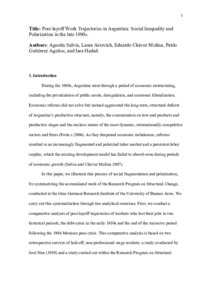 Visualizar/Abrir |

Este ítem está sujeto a una Licencia Creative Commons
